Think Clearly / Human Thought
Rage, Honor, and War
When does the pursuit of honor become self-destruction?
Study how rage, duty, violence, and public recognition can distort moral sight.
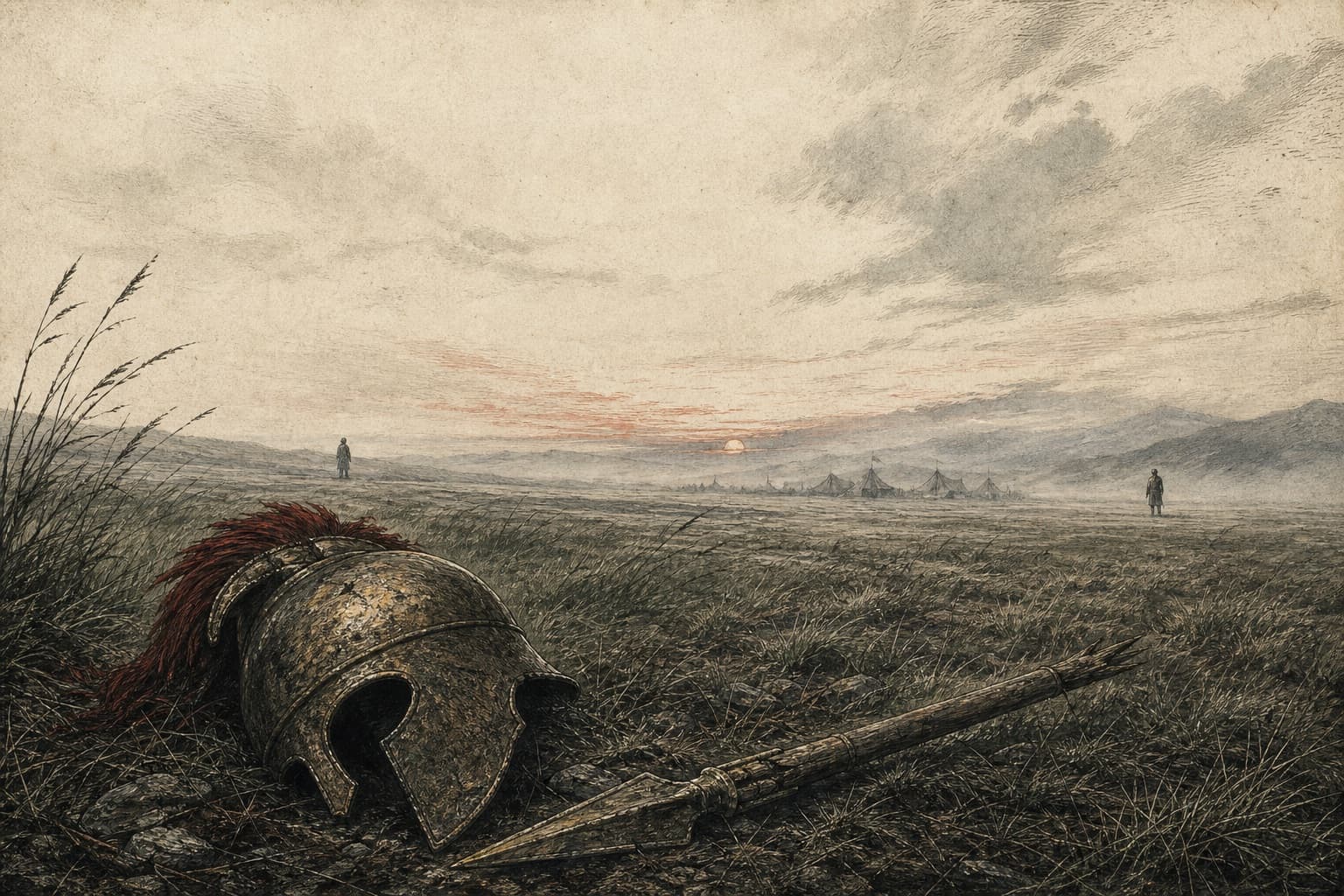
Study how literature thinks about violence, pride, duty, and damaged honor.
Opening Human Problem
You can be right and still be ruled by rage. That is the wound this lesson opens. A person can have a real grievance, a real duty, a real humiliation, a real enemy, or a real injustice before them, and still respond in a way that destroys their judgment. Honor is dangerous because it often begins with something legitimate. You were insulted. Someone failed in duty. A promise was broken. A hierarchy treated you as lesser than you are. A cause really does require courage. A war really may have stakes beyond private comfort. The problem is that honor can become self-enclosing. Once the self feels dishonored, the world narrows. Other people become witnesses, rivals, cowards, traitors, or obstacles. Consequences become secondary. The question stops being, what is right? It becomes, what will restore me? War makes this visible at its most extreme, but the structure appears far from battlefields. It appears in family arguments, company politics, social media status fights, national humiliation, elite competition, religious duty, class anxiety, and any situation where identity fuses with public recognition. This lesson studies three great scenes of conflict:
The lesson is not simply anti-war. That would be too easy and too shallow. The deeper question is: when violence, duty, honor, and public meaning collide, how does a human being keep moral sight?
- Achilles in The Iliad, whose rage begins with a real insult but becomes a force that consumes friend, enemy, and self.
- Arjuna in the Bhagavad Gita, who freezes before battle because duty, kinship, violence, and spiritual judgment collide.
- Tolstoy in War and Peace, who shows war not as clean glory or single heroic will, but as a vast human machine of fear, confusion, vanity, obedience, accident, and suffering.
Why This Question Matters Now
Modern life has not left honor behind. It has changed its costumes. In work, honor appears as credit, ownership, title, authority, reputation, who gets heard, who gets ignored, who is seen as serious, who gets to make the call. In politics, honor appears as national pride, wounded communities, status anxiety, historical memory, insult, revenge, and the need to show strength. In families, honor appears as respect, obedience, sacrifice, pride, shame, and the old hunger to be understood. In technology culture, honor appears as speed, dominance, valuation, genius, being early, being right, and not looking weak. The modern person often claims to be rational, but the honor engine is still ancient. People do not only want outcomes. They want standing. They want recognition. They want their suffering to count. They want their side to be vindicated. They want humiliation answered. This matters because honor is not merely ego. Honor can protect real goods. It can defend dignity. It can resist cowardice. It can stop a person from accepting degradation. It can produce courage under pressure. A society without honor may become soft, transactional, and unable to defend anything sacred. But honor becomes destructive when it demands payment from reality. If I feel insulted, someone must suffer. If my group has been humiliated, history must be reversed through force. If my role says I must act, I must not ask whether the action is wise. If my side is righteous, doubt becomes betrayal. If my status is threatened, truth becomes secondary. That is why these texts remain alive. Achilles shows what happens when honor becomes rage. The Gita shows what happens when duty becomes morally unbearable. Tolstoy shows what happens when societies romanticize war and then are swallowed by forces no commander fully controls. The practical question is not, am I pro-honor or anti-honor? It is: how do I distinguish honor that protects dignity from honor that feeds destruction?
Interactive practice: use the lesson studio below to test this idea in your own case.
Interactive practice: use the lesson studio below to test this idea in your own case.
Voices in Conversation
Homer, The Iliad
The Iliad begins not with strategy, patriotism, or victory, but with rage. Achilles is dishonored by Agamemnon, the leader of the Greek army, who takes Briseis from him as compensation after being forced to return his own prize. The surface issue is a woman treated as war-prize, but inside the heroic code the deeper issue is public worth. Achilles has risked his life and shown excellence, yet Agamemnon uses rank to humiliate him. Achilles' anger is not baseless. Agamemnon really is arrogant. The command structure really is corrupt. Achilles really is the greater warrior. The poem gives Achilles moral force before it shows his danger. This matters because destructive rage often begins from a true perception. But Achilles' rage expands beyond its cause. He withdraws from battle. His fellow Greeks suffer. His desire is not only justice; it becomes vindication. He wants Agamemnon and the army to feel what his absence means. He wants reality to prove his value. Then Patroclus dies. The wound changes shape. Honor becomes grief, and grief becomes revenge. Achilles returns to battle with terrible power. The poem does not deny his greatness. It also does not let greatness become innocence. The Iliad asks: when honor is wounded, can the warrior remain human?
Bhagavad Gita
The Bhagavad Gita begins with paralysis. Arjuna stands between two armies and sees teachers, relatives, friends, and kin on both sides. His problem is not cowardice in the simple sense. He is a warrior who knows how to fight. His crisis is moral perception. He sees that the battle is not an abstraction. It will tear real relationships and stain real lives. Arjuna's honor is tied to duty. He is a Kshatriya, a warrior. The social and cosmic order asks him to act. Yet the action demanded is violent. He asks whether victory is worth the destruction of family and moral order. He wonders whether renunciation would be better than blood-soaked success. Krishna's teaching is complex and dangerous if simplified. He tells Arjuna to act according to duty, but without attachment to fruits. He distinguishes the eternal self from the perishing body. He teaches disciplined action, devotion, insight, and surrender. The point is not merely, do your job. The teaching asks Arjuna to act from a transformed relation to action itself. The Gita asks: when duty requires action that wounds the heart, how should one act without being enslaved by fear, attachment, or ego?
Tolstoy, War and Peace
War and Peace pulls glory down into history, bodies, mistakes, weather, gossip, logistics, vanity, class, family, and confusion. Tolstoy distrusts the fantasy that war is controlled by great men standing above events. He shows generals misreading reality, soldiers experiencing fear and boredom, aristocrats turning war into performance, and history moving through countless small causes. In Tolstoy, war is not only battlefield violence. It is a social machine. It feeds on stories of honor, nation, greatness, and destiny, but it is lived by people who often do not understand the whole. Young men seek glory and discover exhaustion, terror, and absurdity. Commanders claim intention after events have already outrun them. Societies narrate necessity after chaos has done its work. Tolstoy does not deny courage. He does not deny sacrifice. But he attacks the glamour that makes war seem spiritually clean. He asks us to see war as moral injury, historical confusion, and human limitation. War and Peace asks: what if the heroic story we tell about conflict hides the machine we have entered?
What the Tradition Sees
This lesson moves through three human states: rage, paralysis, and disillusionment. Achilles begins in rage. He believes his honor has been violated. He is not wrong about the insult. But his response reveals the central danger of honor: once self-worth depends on public recognition, injury to status feels like injury to being. Achilles does not merely want compensation. He wants the whole Greek army to understand that he is indispensable. This is the rage of the person who wants reality to stage a trial in which his worth is finally proven. The emotion is powerful because it combines truth and vanity. Agamemnon deserves criticism. Achilles deserves honor. But Achilles also lets his grievance become larger than the shared cause. His anger starts as protest and becomes domination by wounded pride. Arjuna begins somewhere very different. He is not angry. He is overwhelmed by moral sight. He sees faces. He sees relationships. He sees that victory may destroy the very world victory is supposed to preserve. His crisis is the opposite of Achilles' narrowing. Achilles sees the insult so intensely that everything else recedes. Arjuna sees too much at once and cannot act. Arjuna's paralysis is not weakness to be dismissed. It is the pain of a person whose inherited role no longer feels morally simple. He is asked to be a warrior, but he sees teachers and kin. He is asked to fulfill duty, but he sees death. He is asked to preserve order, but the means seem to ruin order. Krishna's answer is not modern individual preference. He does not say, follow your feelings. He does not say, avoid all violence. He does not say, maximize happiness. He teaches disciplined action without attachment. Act from duty, but do not make the ego the owner of action. Do what must be done, but do not be intoxicated by reward, fear, or personal glory. This answer can be misused. People have always used duty language to justify violence, hierarchy, obedience, and suppression of conscience. So the lesson must keep pressure on the Gita. Duty is powerful, but duty without moral scrutiny can become machinery. Detachment can liberate action, but detachment can also become a way to avoid feeling the human cost. Tolstoy then enters as a destroyer of clean stories. He looks at the great narratives of war - honor, duty, glory, genius, destiny - and asks what they become when lived by actual people. His world is full of partial knowledge. People rarely understand the historical forces they serve. They dress confusion in noble language. They call accident strategy. They call vanity patriotism. They call obedience greatness. Where Achilles dramatizes heroic rage, and the Gita dramatizes moral duty, Tolstoy dramatizes the limits of human command. War becomes a vast field in which private motives, social performance, fear, chance, and institutional momentum combine. The person inside war may believe he is acting freely and nobly, but he is also being carried. Together, the three sources create a hard teaching:
The mature question is not whether conflict can always be avoided. Some conflicts cannot be avoided without surrendering justice, dignity, or responsibility. The mature question is whether the mind can enter conflict without being possessed by rage, vanity, role, or story.
- Honor can give courage, but it can also make the self fragile and violent.
- Duty can give form to action, but it can also demand terrible sacrifice.
- War can be narrated as glory, but it is lived as confusion, suffering, machinery, and moral residue.
Interactive practice: use the lesson studio below to test this idea in your own case.
Distinction to Hold
The lesson's central distinction separates the visible rule from the deeper practice it is trying to name. Keep the two apart long enough to see what each explains, what each hides, and which one your own case actually requires.
Conflict to Keep Open
The argument becomes useful when its tension is held rather than prematurely resolved. Ask what the principle protects, who pays when it is applied carelessly, and what a person must decide when both sides are true at once.
Where It Touches Your Life
Where does this appear in your life? Start with status injury. Think of the last time you felt disrespected. Not merely disagreed with, but reduced. Ignored. Misread. Treated as less competent, less serious, less central, less worthy. What happened to your mind? Often the mind becomes a courtroom. It starts preparing evidence. It replays the scene. It imagines the perfect reply. It wants witnesses. It wants reversal. It wants the other person to know. The issue may be real, but the inner theater grows larger than the practical problem. That is Achilles. Now think of a duty that felt morally or emotionally complicated. A responsibility to family, company, country, team, friend, employee, or institution. Something where the role said one thing and the heart hesitated. Maybe action would hurt someone. Maybe inaction would betray something. Maybe the right thing had no clean emotional texture. That is Arjuna. Now think of a system you participate in whose story is cleaner than its reality. A company that speaks of mission but runs on status competition. A political movement that speaks of justice but rewards aggression. A family system that speaks of duty but suppresses truth. A nation that speaks of greatness while hiding fragility. An industry that speaks of innovation but also produces anxiety, waste, and imitation. That is Tolstoy. The confrontation is this: which force most often distorts your judgment - rage at insult, paralysis before difficult duty, or participation in a machine whose story you partly know is false? This question is not meant to shame. It is meant to locate the active battlefield. Most modern battles are not fought with spears or chariots. They are fought in attention, speech, incentives, institutional loyalty, family duty, ambition, resentment, and the stories people tell to survive their choices.
Guided Walk Through the Reading
1. Achilles and the truth inside rage
The first line of The Iliad announces rage. This is important. The poem does not begin with the cause of the war or the justice of the Greek expedition. It begins with the force that will organize the story: Achilles' anger. Achilles' anger is attached to honor. Agamemnon has used his authority to take what publicly signifies Achilles' worth. Within the heroic world, prizes are not only possessions. They are visible measures of esteem. To take the prize is to deny the warrior's standing. So Achilles is not merely being childish. He sees something politically real: a leader can exploit the courage of others while preserving his own dominance. Agamemnon is a bad leader in exactly this way. He demands deference but does not embody proportion or justice. This is why rage is seductive. It often contains an accurate moral perception. The angry person may really have been wronged. The insult may really reveal a corrupt structure. The authority may really be unworthy. If we dismiss rage too quickly, we protect injustice. But Homer shows how rage changes scale. Achilles' injury becomes the center of the world. Other Greeks can die so that his value may be revealed. The demand for justice becomes a demand for vindication. He does not only want the wrong corrected. He wants the army's suffering to testify to his importance. This is the transition from dignity to ego-defense. A useful modern test: when you are angry, ask whether you want repair or spectacle. Repair aims to correct the wrong. Spectacle aims to make the world see your wound. Repair can be firm. Spectacle needs an audience. Achilles becomes most terrifying when grief joins rage. Patroclus dies while wearing Achilles' armor. The loss is intimate, not abstract. Achilles is no longer only dishonored; he is bereaved. But because his emotional world is still heroic, grief becomes violence. He cannot mourn without destroying. This is one of the darkest lessons of honor cultures: when tenderness has no language except vengeance, love becomes fuel for brutality.
2. Arjuna and the dignity of hesitation
Arjuna's hesitation is often misunderstood if read too quickly. He is not simply afraid of death. He is overwhelmed by the moral reality of killing people bound to him by kinship, teaching, and shared order. He sees the personal faces inside the category enemy. This is morally significant. Many systems train people to stop seeing faces. War becomes enemy count, collateral damage, strategic necessity, historical destiny. Bureaucracy becomes file, case, headcount, compliance, policy. Business becomes resource allocation. Politics becomes vote bank, base, demographic, messaging target. Arjuna's crisis begins because abstraction fails. He sees the human beings. But the Gita does not leave him in paralysis. Krishna's answer is a discipline of action. You must act. You cannot escape action by refusing to choose. Even withdrawal is a kind of action with consequences. The question is not whether you can stand outside the world, but how to act without being possessed by ego, fear, desire, or attachment to results. This teaching is powerful for anyone carrying responsibility. Parents, founders, leaders, citizens, teachers, and friends all face moments where no option is clean. The fantasy of moral purity can become another form of avoidance. Sometimes action wounds, and inaction wounds too. Yet the Gita must be handled with care. Duty can become a dangerous word. It can silence conscience, freeze hierarchy, and make people instruments of roles they did not examine. A person can say, I am only doing my duty, while refusing responsibility for the human cost. So the right reading must hold two truths:
The deepest discipline is not mechanical obedience. It is transformed action: acting without vanity, without cowardice, without hunger for reward, and without denial of cost.
- Arjuna must not use moral sensitivity as an excuse to abandon necessary action.
- Arjuna must not use duty as an excuse to stop seeing the human beings before him.
3. Tolstoy and the collapse of heroic clarity
Tolstoy is suspicious of grand explanations. In War and Peace, history is not made simply by great men imposing will. Events emerge from countless actions, misunderstandings, habits, accidents, orders, moods, material limits, and collective movements. The heroic view of war is too clean. This is a necessary correction after Achilles and Arjuna. Achilles makes war intensely personal: insult, glory, grief, revenge. The Gita makes war spiritually and morally cosmic: duty, self, action, detachment, order. Tolstoy makes war historical and social: a machine no participant fully comprehends. For Tolstoy, people often narrate themselves falsely. A prince imagines glory and meets confusion. A commander imagines control and meets contingency. A society imagines patriotic meaning and meets mud, hunger, fear, bureaucracy, rumor, and death. The story told about war is not the same as war. This matters beyond literal war. Modern institutions also run on heroic stories. Founders imagine vision, but companies also move through incentives, hiring errors, investor pressure, market accidents, status games, coordination failures, and exhaustion. Nations imagine destiny, but states also move through files, police stations, roads, budgets, media loops, local power, and administrative simplification. Families imagine love and duty, but they also move through money, illness, resentment, silence, habit, and memory. Tolstoy asks for humility before complexity. This humility does not abolish responsibility. It attacks vanity. If you are inside a machine, do not pretend you are standing above it. If you are telling a clean story, ask what the story hides.
4. War as glory, duty, machine, and moral injury
The curriculum names four views of war: glory, duty, machine, and moral injury. War as glory is Achilles' world. It says conflict reveals excellence. Danger strips away mediocrity. Honor becomes visible only when risk is real. This view can produce courage, but it can also make death beautiful from too great a distance. War as duty is Arjuna's world. It says action may be required by role, order, justice, or cosmic law. Personal discomfort cannot be the final judge. This view can produce responsibility, but it can also make obedience look sacred. War as machine is Tolstoy's world. It says individuals are caught in systems, stories, logistics, commands, errors, and mass movement. This view can produce realism, but it can also tempt people to fatalism. War as moral injury names what remains after the stories fail. A person may survive the conflict and still carry the wound of what they did, saw, obeyed, failed to prevent, or became. Moral injury is not only fear. It is damage to the sense that one's actions and world are morally whole. The lesson is to keep all four views visible. If you see only glory, you become dangerous. If you see only duty, you may become an instrument. If you see only machine, you may surrender agency. If you see only injury, you may become unable to act when action is needed.
Cases for Reflection
Work and leadership
In a company, honor appears whenever credit, authority, or seriousness is at stake. A founder can become Achilles when criticism feels like humiliation. A manager can become Agamemnon when title substitutes for earned authority. A team member can become Arjuna when duty to the company conflicts with duty to truth, family, health, or conscience. The organization can become Tolstoyan when everyone repeats the mission while incentives quietly drive different behavior. The practical question: in the conflict before you, what is the actual good at stake, and what is just status pain?
Family
Family is full of duty and honor. Respect, sacrifice, obligation, elder authority, care, shame, and loyalty all matter. Sometimes duty protects love. Sometimes duty becomes emotional coercion. Sometimes the demand for respect hides fear of losing control. Arjuna is useful here because he refuses abstraction. He sees kin. The Gita is useful because it refuses pure avoidance. Tolstoy is useful because family systems are machines too: patterns built over years, not merely individual choices. The practical question: what duty is real here, and what inherited script is pretending to be duty?
Politics and national life
Nations are extremely vulnerable to wounded honor. Historical humiliation, border conflict, civilizational pride, religious identity, and status among nations can make populations feel like Achilles at scale. Leaders know this. They can convert status injury into support for aggression. At the same time, a nation without dignity can accept domination. Honor matters for self-respect and sovereignty. The difficulty is distinguishing defense of dignity from addiction to spectacle. The practical question: is this political action protecting a real good, or feeding the public need to feel strong?
Technology and elite competition
Technology culture often frames conflict as speed, disruption, winning, talent density, category dominance, and being inevitable. Some of this is useful. Competitive pressure can produce excellence. But it can also create honor games disguised as rational markets. A founder may say the issue is strategy when it is really status. An investor may say conviction when it is really fear of missing out. A technologist may say progress when it is really desire to dominate the future narrative. Tolstoy's warning is helpful: the story of genius often hides the machine of capital, timing, labor, institutions, regulation, luck, and social imitation. The practical question: what story of greatness is this system telling, and what machinery does that story hide?
Lens to Carry Forward
This lesson makes conflict visible as a test of judgment. Achilles shows the truth and danger of wounded honor. Arjuna shows the moral difficulty of duty under violent conditions. Tolstoy shows the machinery and confusion hidden beneath stories of glory and command. The portable lens is honor as dignity versus honor as ego-defense. When conflict appears, ask:
The unresolved question is whether human beings can keep courage without becoming intoxicated by honor, and keep moral sensitivity without becoming unable to act.
- What real good is being defended?
- What wound to status is intensifying the situation?
- What duty is actually mine?
- What human faces am I abstracting away?
- What machine or story am I inside?
- What action would remain defensible without rage, applause, or self-deception?
Interactive practice: use the lesson studio below to test this idea in your own case.
Question for Discussion
When does anger become morally useful, and when does it become a demand that the world restore your image? Answer through one concrete case from your own life, work, family, or politics. Do not answer abstractly.
Philosophical Practice
Spend 10 to 20 minutes on one live or recent conflict. Write four short lines:
Then finish this sentence: In this conflict, courage would mean \[X\], but vanity would mean \[Y\].
- The dignity claim: what real good, boundary, duty, or respect was at stake?
- The ego claim: what part of me wanted vindication, status repair, or visible victory?
- The Arjuna hesitation: what human cost or relationship did I not want to see?
- The Tolstoy machine: what system, incentive, role, or story was carrying the conflict beyond individual intention?
Five Days of Reflection
- Think of one situation where your sense of honor, status, or being respected made the situation harder to see clearly. What did that feeling protect, and what did it distort? A rough 5-10 minute answer is enough.
- Defend Achilles for five minutes. Why might rage be the right response to a real insult or corrupt authority?
- Defend Arjuna against Achilles. Why might hesitation before conflict be a sign of moral seriousness rather than weakness?
- Apply Tolstoy to a modern institution: a startup, state, family, political party, or university. What story of glory or duty does it tell, and what machine does that story hide?
- Write one rule for yourself about anger: a sentence that helps distinguish dignity from ego-defense.
Interactive practice: use the lesson studio below to test this idea in your own case.
Interactive practice: use the lesson studio below to test this idea in your own case.
Response Before You Leave
Do not move to Lesson 3 until Avinash responds to the active prompt, challenges the premise, or explicitly asks to skip.
Further Guided Reading
A fourth complication is legitimacy. People do not evaluate systems only by output. They ask whether the rules are intelligible, whether burdens are shared, whether voice matters, and whether the future remains open to them. For Rage, Honor, and War, treat this as reading pass 31: test what the claim leaves out before carrying it into the next case.
A fifth complication is substitution. When one scarce resource becomes cheap, people often discover a new scarcity. More information can make context more valuable. More capability can make trust and responsibility more important. For Rage, Honor, and War, treat this as reading pass 32: test what the claim leaves out before carrying it into the next case.
The lesson's mechanism should therefore be read as a sequence of questions: what became easier, what stayed hard, who controls the hard part, and what kind of person or institution the arrangement asks the learner to become. For Rage, Honor, and War, treat this as reading pass 33: test what the claim leaves out before carrying it into the next case.
Return to the sources after this reconstruction. A source is more legible when the learner knows what problem it is solving. Agreement is not required; accurate representation is. For Rage, Honor, and War, treat this as reading pass 34: test what the claim leaves out before carrying it into the next case.
Now return to the opening problem. The point is not to decorate the question with theory, but to see which part of the question was previously invisible. For Rage, Honor, and War, treat this as reading pass 35: test what the claim leaves out before carrying it into the next case.
A strong conclusion does not say that everything is complicated. It says exactly which relationship matters, which assumption is carrying the weight, and which observation would make the learner revise the account. For Rage, Honor, and War, treat this as reading pass 36: test what the claim leaves out before carrying it into the next case.
Move one: name the phenomenon without celebrating or condemning it. Description is not neutrality; it is the discipline that makes later judgment less theatrical. For Rage, Honor, and War, treat this as reading pass 37: test what the claim leaves out before carrying it into the next case.
Move two: reconstruct the causal chain. Start with the initial condition, follow the incentive, identify the bottleneck, and state the feedback loop in ordinary language. For Rage, Honor, and War, treat this as reading pass 38: test what the claim leaves out before carrying it into the next case.
Move three: separate the visible result from the hidden transfer. Every system distributes time, risk, attention, status, money, or agency. A gain in one column may be paid for in another. For Rage, Honor, and War, treat this as reading pass 39: test what the claim leaves out before carrying it into the next case.
Move four: test the argument at a different scale. What seems reasonable for one person may be destructive when adopted by a firm or state. What seems inefficient at the level of a system may protect dignity at the level of a person. For Rage, Honor, and War, treat this as reading pass 40: test what the claim leaves out before carrying it into the next case.
Move five: ask what would count as evidence against the lesson's preferred explanation. If no observation could change the view, the claim is acting as identity rather than analysis. For Rage, Honor, and War, treat this as reading pass 41: test what the claim leaves out before carrying it into the next case.
The most important complication is that people adapt. Once a rule becomes visible, actors change their behavior around it. This is why a static snapshot can mislead and why institutions need feedback, revision, and humility. For Rage, Honor, and War, treat this as reading pass 42: test what the claim leaves out before carrying it into the next case.
Another complication is timing. A short-term cost can create a long-term capacity, while a short-term gain can consume the complement that made the gain possible. The lesson's chart is a map of relations, not a promise about a date. For Rage, Honor, and War, treat this as reading pass 43: test what the claim leaves out before carrying it into the next case.
A third complication is distribution. The average outcome can improve while the median person's position worsens. Aggregate success is therefore evidence of a change, not proof that the change is broadly shared. For Rage, Honor, and War, treat this as reading pass 44: test what the claim leaves out before carrying it into the next case.
Interactive lesson studio
Change one assumption. Defend what moves.
Rage, Honor, and War sandbox: change the main assumption and observe which outcome moves first.
Chart data fallback
| Measure | Illustrative value |
|---|---|
| dignity versus ego-defense | 72 |
| duty under violence | 67 |
| Observed outcome | 52 |
| Unmeasured cost | 41 |
Asset kit
Materials for this lesson
These materials are part of the lesson, not prerequisites. Use them after the reading to test the mechanism and make the final artifact.
Source spine
Read the disagreement, not just the names
The reading above explains the role each source plays. Return to the source when you want a longer argument, primary text, or evidence trail.