Think Clearly / Human Thought
Duty Under Pressure
Is doing one's duty enough to live well?
Compare duty as role, relationship, discipline, conscience, and the danger of hiding responsibility inside obedience.
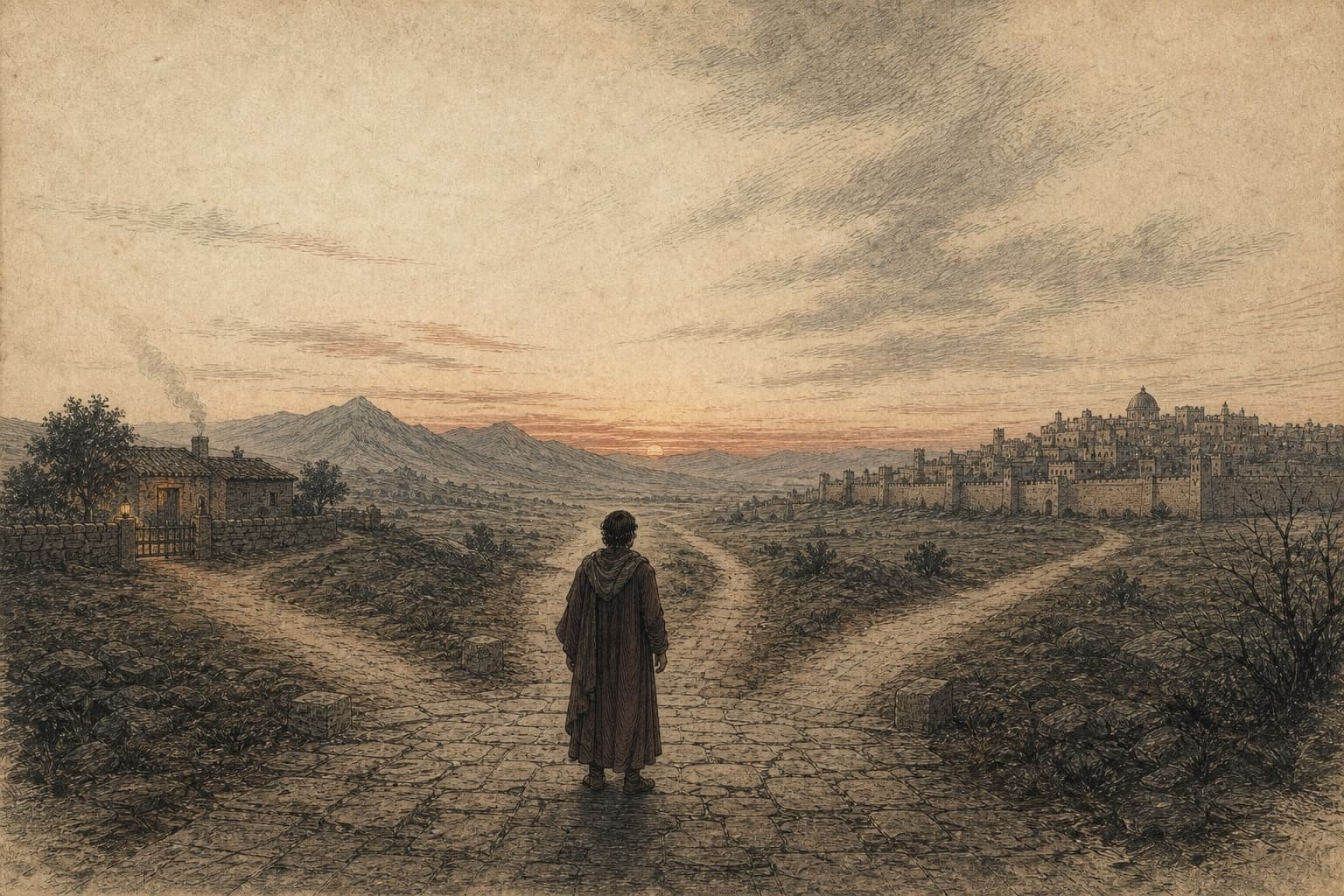
Compare duty as social role, cosmic obligation, and moral discipline.
Opening Human Problem
Sooner or later, responsibility stops feeling noble and starts feeling heavy. You may know what your role requires and still resist it. A parent is tired of being needed. A leader must make a decision that will disappoint people. A child must care for an aging parent while trying to build an independent life. A professional sees that loyalty to the institution may conflict with loyalty to the truth. A citizen is asked to obey a rule that may be lawful but unjust. In each case, the word duty appears, but it does not settle the matter. Duty is one of humanity's oldest answers to chaos. It tells us that life is not only appetite, mood, or private preference. We inherit relationships. We occupy roles. Other people depend on us. The world continues because someone keeps a promise when breaking it would be easier, performs an ordinary task without applause, and accepts burdens that cannot be made glamorous. But duty has a shadow. The same word can dignify sacrifice or excuse cruelty. It can form character or silence conscience. It can mean, I will do what is mine to do. It can also mean, I refuse to think about what I am doing because a role, superior, tradition, or system has already thought for me. This chapter asks what happens when duty comes under pressure: when roles collide, when results are uncertain, when obedience is morally uncomfortable, and when the person performing the duty wants either reward or escape. Three traditions give us three demanding pictures:
None says, simply, obey. Each asks for discipline. Yet each also exposes a danger: the possibility that moral seriousness becomes submission to a role. The human problem is not only whether we will do our duty. It is whether we can do it without surrendering judgment.
- The Bhagavad Gita places Arjuna between action and moral paralysis, then asks him to act without being possessed by the result.
- Confucius treats duty as relational practice: becoming humane through family, ritual, learning, and responsible participation in a shared order.
- Marcus Aurelius turns duty inward, training himself to perform the work of a rational and social being without complaint, vanity, or dependence on praise.
Why This Question Matters Now
Modern people often imagine themselves as free choosers. We choose careers, relationships, beliefs, locations, identities, diets, tools, and ways of presenting ourselves. Even inherited obligations are frequently described as options: stay or leave, accept or renegotiate, care or outsource, belong or detach. This freedom is real and valuable. Many traditional duties were unjust. They trapped women inside service, younger people inside obedience, lower-status groups inside hierarchy, and dissenters inside silence. The ability to question a role is a moral achievement. But the language of choice can hide dependence. A hospital works because someone takes the night shift. A family survives illness because someone rearranges a life. A team endures a crisis because someone handles the uncelebrated work. A democracy persists because citizens do more than consume its protections. A friendship becomes real when inconvenience arrives. Human life is built from obligations that cannot all be optimized around personal preference. This produces a modern confusion. On one side is the fear of being used. People have learned to ask whether a workplace, family, nation, or tradition is exploiting their loyalty. On the other side is the temptation to treat every burden as a violation. The first fear protects freedom. The second temptation can make durable commitment impossible. Duty also appears in institutions that divide responsibility into small pieces. A person follows a process, applies a policy, ships a feature, approves a transaction, or carries out an order. Each action may look minor. Together they may create consequences no participant fully owns. In such systems, “I did my job” becomes morally ambiguous. The statement may describe admirable reliability. It may also be an alibi. The pressure becomes sharper when duties conflict. Your duty to tell the truth may oppose your duty to protect a confidence. Your duty to family may oppose your duty to work. Your duty to law may oppose your duty to justice. Your duty to a team may oppose your duty to a person harmed by that team. Your duty to preserve your health may oppose another person's urgent need. No rule can remove all such conflict. The serious task is to become the kind of person who can distinguish fidelity from fear, sacrifice from submission, and principled duty from moral outsourcing.
Interactive practice: use the lesson studio below to test this idea in your own case.
Interactive practice: use the lesson studio below to test this idea in your own case.
Voices in Conversation
Bhagavad Gita
The Bhagavad Gita begins inside a crisis of duty. Arjuna is a warrior facing a battle in which teachers, relatives, and companions stand among the enemy. His role says fight. His moral imagination sees the people who will be killed. He lowers his bow. Krishna does not answer by pretending the conflict is harmless. He reframes action. Arjuna cannot avoid participation merely by refusing to move; withdrawal also has consequences. He must understand his dharma, the discipline appropriate to his place and nature, while loosening his attachment to victory, loss, pleasure, fear, and personal reward. Action is necessary, but possessiveness about action is not. The Gita's challenge is not mechanical obedience. It is action purified of ego: act without turning the result into proof of your worth. This can produce courage under uncertainty. It also creates a permanent interpretive danger. If duty is detached from moral scrutiny, the language of cosmic order can sanctify violence or hierarchy. The text therefore forces a question rather than ending one: can a person act decisively without becoming either paralyzed by consequence or protected from responsibility by role?
Confucius, Analects
Confucius begins not on a battlefield but in ordinary relationships. The Analects asks how a person becomes humane through learning, ritual, attention, family life, speech, public service, and repeated conduct. Character is not invented privately. It is formed in relation. Ritual is central, but ritual is more than ceremony. It gives shape to respect. It teaches the body how to carry regard for elders, guests, ancestors, rulers, children, and neighbors. Proper performance can educate feeling: by acting with care, one may become capable of deeper care. Duties are therefore not merely limits on the self. They are practices through which a self becomes trustworthy. Yet Confucian duty is not blind compliance. Names and roles carry standards. A ruler must rule well to deserve the name ruler. A child owes respect, but a responsible son may also remonstrate. Harmony is not the absence of truth; it is an order in which correction can occur without dissolving relationship. The danger remains obvious. Deference can become domination. Ritual can preserve injustice. Appeals to family harmony can silence those with less power. Confucius helps only if role is understood as reciprocal moral demand, not as a license for the powerful and a burden for everyone else.
Marcus Aurelius, Meditations
Marcus Aurelius writes private reminders while carrying public power. Again and again he tells himself to rise, work, accept difficulty, restrain irritation, and remember that human beings are made for cooperation. His Stoicism makes duty both cosmic and immediate. The universe is not arranged around his comfort; nevertheless, the next just action remains available. Marcus distinguishes what belongs to judgment and action from what belongs to fortune. Reputation, other people's behavior, illness, delay, and political disorder are never fully his. Attention, intention, proportion, and the quality of his act are. This protects duty from dependence on reward. A good act is not made good by applause, and an obligation does not vanish because the mood is absent. His social vision matters. Stoic self-command is not solitary self-improvement. Human beings are parts of a larger whole. To act against others is to damage the community of which one is a part. But acceptance has its own danger. A discipline designed to prevent resentment can also mute justified anger. Endurance can preserve service or preserve a bad system. Marcus asks us to stop demanding that reality obey us; he does not give an easy test for deciding when reality must be resisted.
What the Tradition Sees
Duty begins with a fact that modern individualism often conceals: no one makes a life alone. Before we choose, we receive. We receive bodies, languages, caregivers, histories, institutions, debts, capacities, injuries, and places among other people. Some inherit too much burden and too little freedom. Others inherit benefits made possible by invisible labor. In either case, the self arrives inside a moral world already underway. This is why duty cannot be reduced to preference. If I promise to meet you, the obligation does not disappear when another option becomes more attractive. If a child depends on me, care is not one interest among equal interests. If I accept authority, I acquire responsibilities that accompany power. Duty names the claim that other people and shared goods can make upon my action. The three sources agree on this much, but they locate the claim differently. For the Gita, duty appears within dharma and a cosmic account of action. Arjuna's task cannot be understood only by asking what he wants or what outcome would soothe him. His identity, social function, the justice of the conflict, and the spiritual quality of action all matter. He is called to act, but to release the fantasy that he owns the whole result. For Confucius, duty grows from relationship and cultivated role. The child, parent, friend, official, teacher, and ruler do not meet as abstract individuals. Their roles make different demands. When performed with humaneness, ritual, and practical wisdom, these demands create trust and make social life inhabitable. For Marcus, duty follows from the nature of a rational, social being. The question is not whether the task flatters him. The question is whether it serves justice and the common work of human beings. External difficulty cannot excuse an inward failure of character. Together they challenge three familiar evasions. The first is the evasion of mood: I do not feel like it. Duty replies that feeling matters but is not sovereign. Many acts become possible only when commitment outlasts enthusiasm. The second is the evasion of reward: what will I get? The Gita and Marcus are especially severe here. If the worth of action depends entirely on recognition or success, then principle is only a bargain. Detachment from reward does not mean indifference to consequences. It means that praise, status, and guaranteed victory cannot be the conditions of doing what is right. The third is the evasion of isolation: it is my life. Confucius replies that the “my” was formed by relations it did not create. Freedom is important, but freedom without acknowledgment of dependence becomes ingratitude or fantasy. Yet duty itself creates a fourth evasion: I was only fulfilling my role. This is moral outsourcing. The person hands judgment to an office, rule, tradition, scripture, leader, algorithm, or chain of command. The role becomes a shield between action and conscience. Instead of asking whether the duty is just, how it should be interpreted, what other duties it conflicts with, and who will bear its cost, the person treats compliance as innocence. None of our three sources can be used responsibly if it encourages this escape. Arjuna's transformation must not erase the horror that made him hesitate. Confucian harmony must include reciprocal obligation and the courage to correct. Stoic acceptance must remain joined to justice. Duty needs judgment because roles are human arrangements, and human arrangements can be corrupt. But judgment also needs duty. Without duty, conscience can become whatever the self prefers at the moment. People are talented at giving moral names to convenience. “Authenticity” can mean abandoning someone who depended on us. “Boundaries” can mean refusing ordinary reciprocity. “Speaking my truth” can mean enjoying cruelty. “Questioning authority” can mean avoiding standards. A person who recognizes no claim beyond private judgment may not be liberated. They may simply be unaccountable. The mature position is therefore difficult: a duty deserves fidelity, but not the surrender of agency. You must be formed enough by commitments to resist convenience and awake enough within commitments to resist injustice.
Interactive practice: use the lesson studio below to test this idea in your own case.
Distinction to Hold
The lesson's central distinction separates the visible rule from the deeper practice it is trying to name. Keep the two apart long enough to see what each explains, what each hides, and which one your own case actually requires.
Conflict to Keep Open
The argument becomes useful when its tension is held rather than prematurely resolved. Ask what the principle protects, who pays when it is applied carelessly, and what a person must decide when both sides are true at once.
Where It Touches Your Life
Think of one role in which other people can reliably predict your behavior: child, parent, partner, friend, manager, employee, founder, professional, citizen, believer, caregiver, or member of a community. What does that role ask from you when you are tired, unseen, or unconvinced? Begin with resentment. Resentment sometimes reveals exploitation. It can tell you that a burden has been distributed unfairly, that care is being treated as an unlimited resource, or that a role leaves no room for your own humanity. This kind of resentment deserves investigation. But resentment can also reveal the ordinary cost of commitment. Every durable relationship closes off possibilities. Every promise makes some future choices less available. The fact that a duty limits freedom does not prove that it is unjust. Sometimes the limitation is the shape love takes through time. Now examine where you seek moral cover. When have you said, at least inwardly, “I had no choice,” though you did have some choice? Perhaps refusal would have been costly. Perhaps speaking honestly would have risked status, harmony, income, or belonging. Costly agency is still agency. Then examine your use of conscience. Have you ever renamed convenience as principle? Perhaps you withdrew from a commitment and called it authenticity. Perhaps you resisted feedback and called it independence. Perhaps you refused unglamorous work and called it strategic focus. Private judgment is not automatically courageous merely because it opposes a role. The confrontation becomes sharper when two duties are both real. You may owe presence to family and reliability to colleagues. You may owe confidentiality to one person and protection to another. You may owe respect to a parent and truth to yourself. You may owe loyalty to an institution and disclosure to the public. Conflicting duties cannot always be solved without residue. A mature decision may still leave guilt because a real claim went unmet. Guilt is not always proof that the decision was wrong. Sometimes it is evidence that the neglected good was genuine. Ask of your live conflict:
Duty under pressure rarely offers purity. It asks for accountable action in a world of plural claims.
- Which duty did I explicitly accept?
- Which duty arises from dependence, power, or benefit even without a promise?
- Which claim is urgent, and which is merely loud?
- Who has less ability to absorb the cost of my decision?
- What would I choose if no one praised my sacrifice or my rebellion?
- After choosing, what repair will I owe to the good I could not serve?
Guided Walk Through the Reading
1. Arjuna: action without possession
The previous chapter met Arjuna at the moment of hesitation. Here we stay with what follows. Krishna's teaching does not merely push him back into battle. It attempts to transform the consciousness from which he acts. Arjuna is attached in several directions. He fears the destruction of kinship and order. He anticipates guilt. He also occupies a warrior role whose honor and obligations pull toward action. If he fights, he may become the agent of catastrophe. If he refuses, he may abandon a cause and leave others to bear the consequences. There is no innocent position outside the field. Krishna's discipline of action addresses this entanglement. Attend to the act that is yours, but do not make yourself lord of the result. Results emerge from many causes. You control neither victory nor the judgment of history. Attachment to success can make action anxious, manipulative, and vain. Attachment to avoidance can make moral sensitivity serve fear. This idea is easily caricatured as “ignore outcomes.” That would be irresponsible. Consequences matter to judgment. Detachment concerns ownership and ego, not attention. You should think carefully about likely harm, revise action when evidence changes, and accept responsibility for foreseeable effects. What you release is the demand that reality guarantee success or protect your self-image. This is useful wherever duty meets uncertainty. A doctor can act skillfully without controlling whether a body heals. A parent can guide without owning a child's future. A leader can make a necessary decision without controlling how every person interprets it. A citizen can defend a principle without knowing whether the cause will win. The danger is spiritualized obedience. Anyone with power can tell another person that doubt is attachment and compliance is duty. Arjuna's crisis must remain visible. The teaching is valuable only when detachment reduces ego while moral perception stays awake.
2. Confucius: the education of relationship
Confucian ethics begins from a different picture of the self. You are not first an isolated chooser who later enters relationships. You become a person through them. Language, manners, memory, affection, expectations, and moral imagination are learned among others. This makes ordinary conduct philosophically important. How you greet, listen, mourn, host, disagree, remember, and carry responsibility is not decorative etiquette. These forms teach what and whom to notice. Ritual at its best slows the ego and gives visible shape to regard. Consider apology. A spontaneous feeling of regret may be sincere but fleeting. The form of apology requires the person to name the act, acknowledge harm, face another, and accept a changed relationship. The form does not guarantee sincerity, but it can educate sincerity. The same is true of keeping a vigil, attending a funeral, sharing a meal, or showing up at an agreed time. Confucian duty is therefore thicker than rule-following. It asks whether conduct expresses humaneness and fits the relationship. The appropriate act for a friend is not identical to the act for an official. Equality of worth does not mean sameness of obligation. This relational account corrects the fantasy that freedom means being untouched by claims. But it can also romanticize inherited order. Families distribute care unequally. Ritual can humiliate outsiders. Harmony can be maintained by making the less powerful absorb conflict. The phrase “respect your role” often travels downward more easily than upward. A responsible Confucian reading emphasizes reciprocity and moral standards internal to roles. A parent owes care, not merely authority. A ruler owes justice, not merely command. A child may correct with respect rather than obeying harm. The role is not whatever the powerful declare it to be. The contemporary lesson is not to reproduce an ancient hierarchy. It is to see that responsibilities live in relationships and that relationships require practices. Love without form is unreliable. Form without humaneness is empty.
3. Marcus Aurelius: do the next human work
Marcus repeatedly confronts the distance between responsibility and mood. Morning arrives; he would prefer comfort. Other people are vain, ungrateful, irritating, or mistaken. Public work is exhausting. Death makes ambition look brief. Why rise and continue? His answer is function. A human being is made for rational and social activity. Just as a craft has work proper to it, human life has the work of attention, cooperation, justice, and proportion. To remain in bed solely because it is pleasant is to let appetite govern purpose. This sounds severe, but Marcus's discipline can be liberating. It removes the need to feel heroic before acting. The next duty may be small: answer clearly, hear a complaint, control irritation, make a fair decision, finish the task, accept the delay. The world does not need your performance of burden. It needs the act. Marcus also weakens the demand for recognition. If another person fails to notice the work, the work does not become worthless. If someone behaves badly, their character need not determine yours. This is not passivity. It is refusal to outsource the quality of your action to the behavior of others. Yet the image of natural function raises hard questions. Who defines the work proper to a person? Historical societies have declared subordination “natural” with great confidence. Stoic endurance can be taught to the burdened while comfort remains with the powerful. A worker may be told to control attitude instead of challenging exploitation. The safeguard is Marcus's commitment to justice and shared membership in a human whole. Self-command should increase the capacity to serve and correct, not make domination easier for others. The next human work may be patient endurance. It may also be telling the truth, changing the rule, protecting someone, or leaving the role.
4. When duties collide
The cleanest accounts of duty imagine one clear obligation opposed by appetite. Many real cases are harder because obligations collide. Suppose a manager discovers that a respected colleague has harmed a junior employee. Loyalty to the colleague calls for fairness and confidentiality. Duty to the junior calls for safety and serious response. Duty to the institution calls for due process. Duty to truth calls for refusing a quiet cover-up. No single role contains the whole moral field. The Gita contributes steadiness: do not let fear of reputation or desire for an easy outcome decide. Confucius contributes relational perception: see the particular people and the responsibilities created by power, trust, and dependence. Marcus contributes self-command: govern defensiveness, act justly, and accept that you cannot control every response. We can add four tests. First, test legitimacy. Is the claimed duty attached to a worthy purpose, or merely to authority? A command is not a duty simply because someone powerful issued it. Second, test vulnerability. When duties conflict, attend to the person least able to bear the harm. Power creates responsibility. Third, test publicity. Could you explain the act honestly to those affected, without hiding relevant facts or retreating into jargon? Secrecy is not always wrong, but the need for euphemism is evidence. Fourth, test residue. What will remain owed after the decision? If you cannot serve both family and work in a crisis, the neglected duty may require apology, repair, delegation, or a changed commitment. A tragic conflict is not resolved by pretending the losing claim never mattered. These tests will not produce certainty. They prevent two forms of self-deception: the fantasy that a role makes you innocent, and the fantasy that private sincerity makes you right.
Cases for Reflection
Family and care
Family duty is powerful because it begins before explicit consent. Children receive care they cannot repay symmetrically. Parents, siblings, spouses, and elders become vulnerable in ways that create real claims. Yet “family duty” can also be used to control education, marriage, money, identity, and silence. Ask: what care is owed because of genuine dependence, and what obedience is being demanded to preserve someone else's authority or image? Respect does not require making another person the author of your life. Independence does not eliminate gratitude or care.
Work and professional roles
Professional duty protects standards from mood and pressure. Engineers must surface risks. Doctors owe care beyond convenience. Teachers owe attention to students, not only completion of a syllabus. Leaders acquire greater responsibility as authority increases. The danger is role fragmentation. A person completes one narrow task and refuses to see the larger consequence. Ask: what human purpose gives this role legitimacy, and does my performance actually serve it? Competence without moral ownership can make harmful systems efficient.
Leadership and loyalty
Loyalty allows teams to survive difficulty. People need to know that disagreement, error, or temporary weakness will not lead to immediate abandonment. But loyalty becomes corruption when it requires concealing harm or protecting status. A worthy leader makes remonstrance possible. A worthy colleague can distinguish criticism from betrayal. Ask: am I protecting a person through a fair process, or protecting them from accountability because their fall would threaten my identity or position?
Citizenship and law
Law coordinates strangers and restrains arbitrary power. A citizen cannot treat every disliked rule as optional. But legality is not the whole of justice. History contains laws that demanded resistance and institutions whose procedures concealed harm. The question is not simply obey or disobey. Ask what good the law serves, whether avenues of correction remain open, who bears the cost of compliance, and what form of resistance is proportionate and accountable.
Technology and delegated judgment
Algorithms increasingly recommend who receives attention, credit, employment, insurance, care, scrutiny, or access. A person may defer because the system appears neutral or too complex to challenge. “The model decided” becomes a new version of “I followed orders.” Tools can inform judgment; they cannot carry moral responsibility. Someone chose the objective, data, threshold, and deployment context. Ask who can contest the output, who answers for error, and whether the person affected is still visible behind the score.
Lens to Carry Forward
This lesson treats duty as necessary but unfinished moral language. The Bhagavad Gita teaches disciplined action without possession of the result. Confucius teaches that duties and practices inside relationships form humane character. Marcus Aurelius teaches that the next just act does not depend on comfort, praise, or control of the world. Together they resist a life governed only by mood, reward, and private preference. They also become dangerous if used to make obedience sacred, hierarchy unquestionable, or endurance a substitute for justice. The portable lens is duty as moral formation versus duty as moral outsourcing. When duty calls, ask:
Doing one's duty is not always enough to live well. But learning to answer responsibly for what is yours to do is part of any life that deserves to be called good.
- What human good makes this obligation legitimate?
- What role, promise, dependence, or power creates the claim?
- What competing duty must remain visible?
- Who bears the cost of my interpretation?
- Would I defend the act in my own name?
- Is this commitment forming courage and care, or teaching me to disappear inside obedience?
Interactive practice: use the lesson studio below to test this idea in your own case.
Question for Discussion
When is refusing a duty an act of conscience, and when is it avoidance dressed as principle? Answer through one concrete case. Name the role, the good it was supposed to serve, the cost of compliance, and the cost of refusal.
Philosophical Practice
Spend 10 to 20 minutes on one live conflict of duty. Write five short lines:
Then finish this sentence: In this situation, fidelity would mean \[X\], while moral outsourcing would mean \[Y\].
- The role: what position, relationship, promise, or power creates an obligation?
- The good: what person or shared value is the duty meant to protect?
- The collision: what other genuine duty is competing with it?
- The authorship test: what part of the choice must you defend in your own name?
- The residue: after choosing, what apology, repair, delegation, or new boundary will still be owed?
Five Days of Reflection
- Identify one obligation you perform without recognition. What makes it worth continuing, and what limit would keep it from becoming exploitation? A rough 5-10 minute answer is enough.
- Defend Arjuna's duty to act. Why can the refusal to choose become another way of protecting the self?
- Apply Confucius to one ordinary ritual: a meal, meeting, greeting, apology, visit, or funeral. What human meaning does the form preserve?
- Apply Marcus to one task you resent. What part is genuinely yours to do, and what part of the resentment contains useful moral information?
- Examine one institutional phrase such as “policy,” “best practice,” “the model,” or “orders.” What responsibility does the phrase clarify, and what responsibility might it conceal?
Interactive practice: use the lesson studio below to test this idea in your own case.
Interactive practice: use the lesson studio below to test this idea in your own case.
Response Before You Leave
Do not move to Lesson 4 until Avinash responds to the active prompt, challenges the premise, or explicitly asks to skip.
Further Guided Reading
A fourth complication is legitimacy. People do not evaluate systems only by output. They ask whether the rules are intelligible, whether burdens are shared, whether voice matters, and whether the future remains open to them. For Duty Under Pressure, treat this as reading pass 31: test what the claim leaves out before carrying it into the next case.
A fifth complication is substitution. When one scarce resource becomes cheap, people often discover a new scarcity. More information can make context more valuable. More capability can make trust and responsibility more important. For Duty Under Pressure, treat this as reading pass 32: test what the claim leaves out before carrying it into the next case.
The lesson's mechanism should therefore be read as a sequence of questions: what became easier, what stayed hard, who controls the hard part, and what kind of person or institution the arrangement asks the learner to become. For Duty Under Pressure, treat this as reading pass 33: test what the claim leaves out before carrying it into the next case.
Return to the sources after this reconstruction. A source is more legible when the learner knows what problem it is solving. Agreement is not required; accurate representation is. For Duty Under Pressure, treat this as reading pass 34: test what the claim leaves out before carrying it into the next case.
Now return to the opening problem. The point is not to decorate the question with theory, but to see which part of the question was previously invisible. For Duty Under Pressure, treat this as reading pass 35: test what the claim leaves out before carrying it into the next case.
A strong conclusion does not say that everything is complicated. It says exactly which relationship matters, which assumption is carrying the weight, and which observation would make the learner revise the account. For Duty Under Pressure, treat this as reading pass 36: test what the claim leaves out before carrying it into the next case.
Move one: name the phenomenon without celebrating or condemning it. Description is not neutrality; it is the discipline that makes later judgment less theatrical. For Duty Under Pressure, treat this as reading pass 37: test what the claim leaves out before carrying it into the next case.
Move two: reconstruct the causal chain. Start with the initial condition, follow the incentive, identify the bottleneck, and state the feedback loop in ordinary language. For Duty Under Pressure, treat this as reading pass 38: test what the claim leaves out before carrying it into the next case.
Move three: separate the visible result from the hidden transfer. Every system distributes time, risk, attention, status, money, or agency. A gain in one column may be paid for in another. For Duty Under Pressure, treat this as reading pass 39: test what the claim leaves out before carrying it into the next case.
Move four: test the argument at a different scale. What seems reasonable for one person may be destructive when adopted by a firm or state. What seems inefficient at the level of a system may protect dignity at the level of a person. For Duty Under Pressure, treat this as reading pass 40: test what the claim leaves out before carrying it into the next case.
Move five: ask what would count as evidence against the lesson's preferred explanation. If no observation could change the view, the claim is acting as identity rather than analysis. For Duty Under Pressure, treat this as reading pass 41: test what the claim leaves out before carrying it into the next case.
The most important complication is that people adapt. Once a rule becomes visible, actors change their behavior around it. This is why a static snapshot can mislead and why institutions need feedback, revision, and humility. For Duty Under Pressure, treat this as reading pass 42: test what the claim leaves out before carrying it into the next case.
Another complication is timing. A short-term cost can create a long-term capacity, while a short-term gain can consume the complement that made the gain possible. The lesson's chart is a map of relations, not a promise about a date. For Duty Under Pressure, treat this as reading pass 43: test what the claim leaves out before carrying it into the next case.
A third complication is distribution. The average outcome can improve while the median person's position worsens. Aggregate success is therefore evidence of a change, not proof that the change is broadly shared. For Duty Under Pressure, treat this as reading pass 44: test what the claim leaves out before carrying it into the next case.
Interactive lesson studio
Change one assumption. Defend what moves.
Duty Under Pressure sandbox: change the main assumption and observe which outcome moves first.
Chart data fallback
| Measure | Illustrative value |
|---|---|
| role and responsibility | 66 |
| discipline and attachment | 72 |
| Observed outcome | 56 |
| Unmeasured cost | 46 |
Asset kit
Materials for this lesson
These materials are part of the lesson, not prerequisites. Use them after the reading to test the mechanism and make the final artifact.
Source spine
Read the disagreement, not just the names
The reading above explains the role each source plays. Return to the source when you want a longer argument, primary text, or evidence trail.